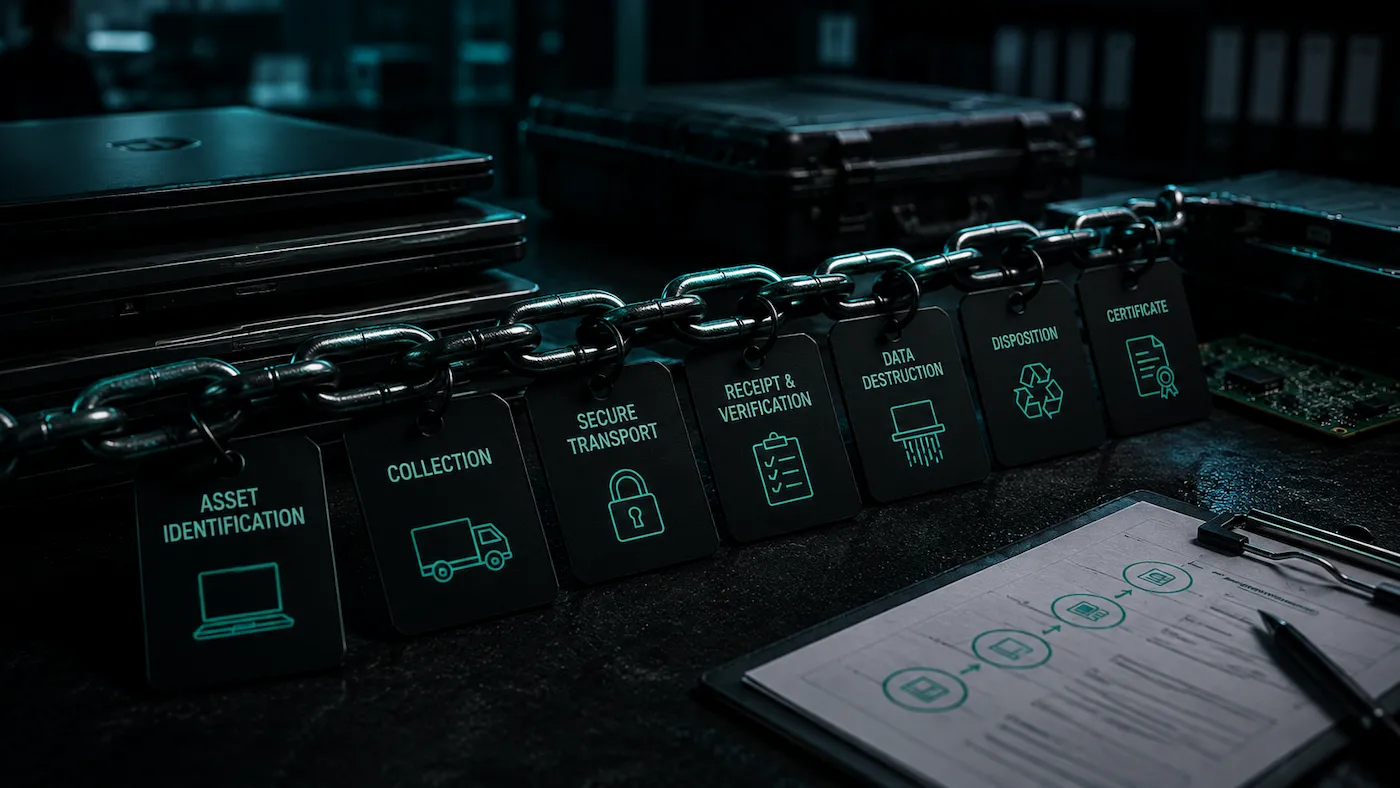
Building an Audit-Ready IT Asset Disposal Process
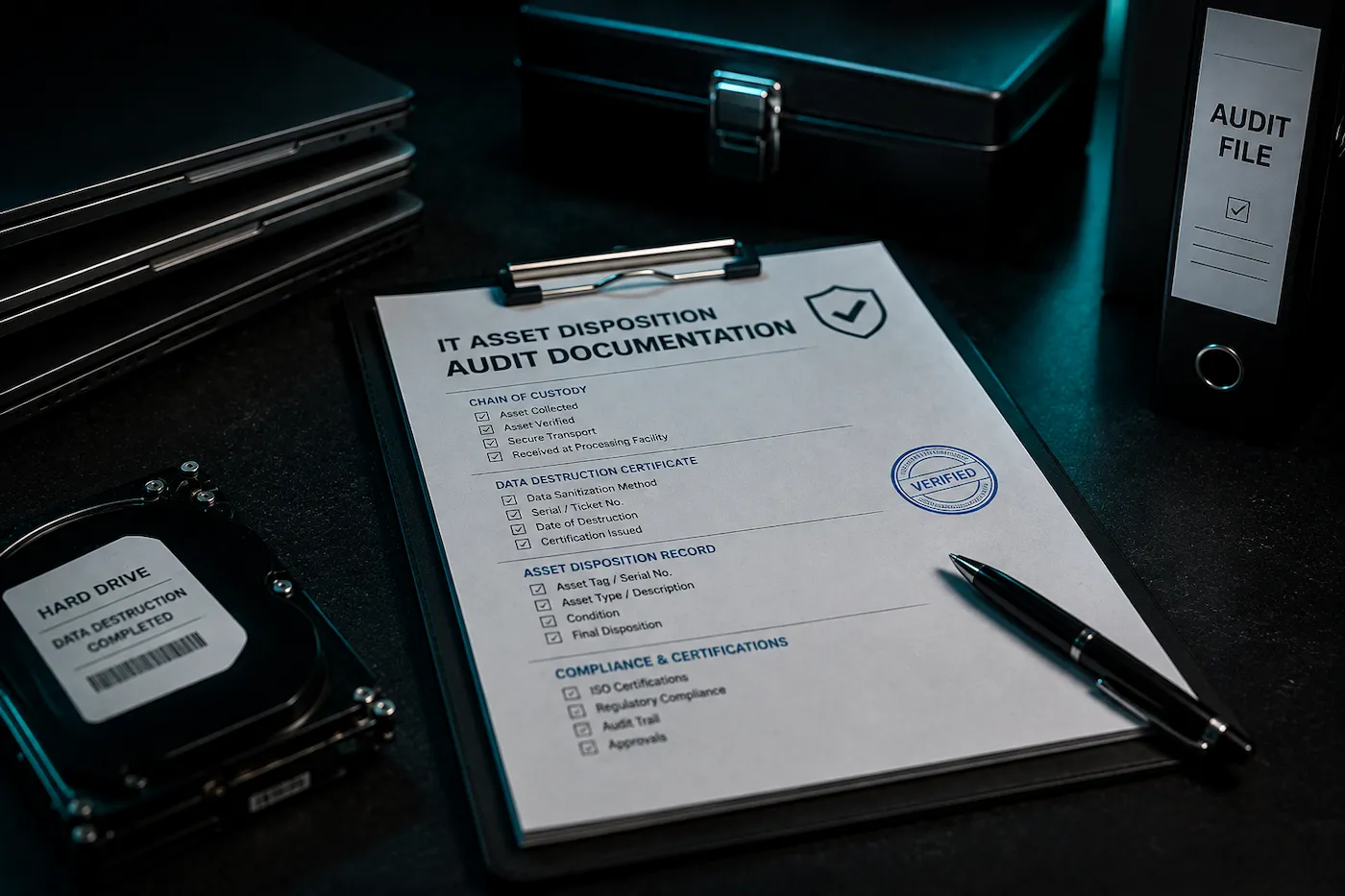
An audit-ready disposal process needs four things: a written policy that covers hardware, a single authorized disposal channel, a document produced at every collection, and a file where those documents live. That is the whole thing.
Most organisations already do the disposal reasonably well. What they lack is the record. The gap between “we handle it properly” and “here is the evidence” is where audit findings come from.
What an auditor actually tests
Whether it is an ISO 27001 surveillance audit, a client's vendor security review, or an internal control test, the questioning follows a predictable shape:
- Is there a documented policy covering the disposal of media and equipment? Not a general IT policy: a specific statement about what happens to hardware at end of life.
- Can you show it is followed? Policies that exist but are not evidenced are a finding in themselves.
- Pick one disposal event. Show me the record. This is the one that decides the outcome.
- How do you know the vendor did what they said? Testing whether you verified anything or simply trusted.
Question three is where most organisations come apart. Not because the disposal was careless, but because nobody thought to keep the paperwork, or it went into a facilities folder nobody can find.
Building it in five steps
Step 1: Close the informal channel. Today.
Whatever route retired equipment currently takes out of your building, if it does not generate a document, stop it. This costs nothing and immediately stops new gaps forming while you fix the old ones.
Step 2: Choose one authorized channel and verify it once.
One vendor, verified properly, is worth more than three unverified ones. Collect and file: their current pollution control board authorization with expiry date and categories, their information security certification if data destruction is in scope, a sample of the documents you will receive, and a written description of their process. Ask for it as a pack: any serious vendor has one ready.
Step 3: Define what happens at collection.
Who from your side attends. Who signs. What gets recorded, and at what level of detail. Where the signed copy goes. Write this down in six lines; it does not need to be longer.
Step 4: Fix where the documents live.
This sounds trivial and is the single most common failure. The documents belong with your information security records, not in facilities, procurement or someone's inbox. An auditor asking about IT asset disposal will not think to look in the facilities folder, and “we have it somewhere” scores the same as not having it.
Step 5: Add the line to your retention policy.
Most data retention policies describe databases and applications in detail and say nothing about physical hardware. One paragraph fixes it, and it is what makes the process survive the person who set it up.
The policy paragraph most companies are missing
Here is a starting point. Adapt it to your organisation and have it reviewed properly: this is a template, not legal drafting.
“All end-of-life IT equipment capable of storing data shall be retired through an approved disposal vendor whose current pollution control board authorization has been verified and is held on file. Data on all media-bearing devices shall be destroyed by certified erasure, degaussing or physical destruction prior to any resale, dismantling or recycling. A collection record shall be completed and signed by an authorised representative at the point of collection, and a certificate of destruction shall be obtained following processing. Both documents shall be retained with information security records for a period of [X] years. Disposal of IT equipment through informal channels, including scrap sale and individual disposal by employees, is prohibited.”
Four sentences. It gives an auditor a policy to test against and gives your team an unambiguous rule.
Dealing with the backlog
Nearly every organisation has a room. Equipment retired over five, eight, twelve years, disposed of under whatever the practice was at the time, with no record of any of it.
The instinct is to leave it, because dealing with it means admitting it exists. That is backwards. An auditor who finds an undocumented storeroom finds an open, ongoing exposure. An auditor who is told “we identified a historical backlog and cleared it through an authorized channel on this date, here is the documentation” finds a closed issue and a functioning control.
Clear it in one documented batch. It is usually free, because retired equipment carries recoverable value that covers the cost of collection. What it costs is a decision.
The evidence file
What should be in it, in one place:
- The disposal policy or the clause in your wider policy
- The vendor's current authorization, and a diary note for its expiry
- The vendor's information security certification, where data destruction is in scope
- A written description of the disposal process
- Every collection record, in date order
- Every certificate of destruction, matched to its collection record
- A note of the historical backlog clearance, with its documents
That file is the entire answer to question three. Build it once, add to it after each collection, and disposal stops being the awkward part of the audit.
Our page for compliance teams lists exactly what PrivAce supplies for this file, and the exposure score will tell you in ninety seconds which of the five steps above you are already doing.