What Happens If You Get E-Waste Disposal Wrong in India
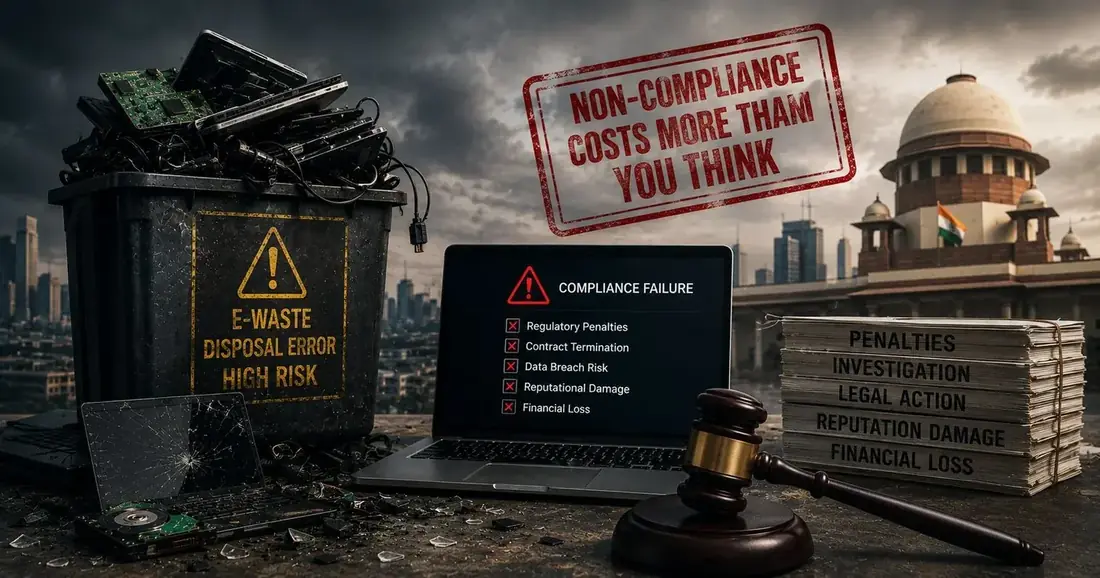
Conversations about e-waste penalties tend to jump straight to fines. That framing is misleading, because the fine is rarely the first or the largest cost. For most Indian businesses, the damage from getting disposal wrong arrives through channels that have nothing to do with a regulator writing a cheque demand.
How exposure actually surfaces
In our experience, organisations discover a disposal problem through one of four routes, and almost never through a proactive inspection:
- An internal or statutory audit asks for documentation the organisation cannot produce.
- A client's vendor review requires evidence of secure disposal as a condition of contract renewal.
- A data incident is traced back to hardware that left the building without proper erasure.
- A due diligence process, an acquisition, an investment round, a large tender, surfaces the gap under time pressure.
All four share a characteristic: the problem was created months or years earlier, and is discovered at a moment when fixing it retroactively is impossible. You cannot generate a chain-of-custody record for a pickup that happened in 2024 and wasn't documented.
Regulatory consequences
India's e-waste framework sits under the Environment (Protection) Act, 1986, with rules administered by CPCB and the state boards. Non-compliance can attract action under that parent legislation, and boards have mechanisms including environmental compensation, directions to cease specified activity, and refusal or withdrawal of consents.
Two points matter more than the specific quantum:
- Obligations follow the generator. Handing equipment to an unauthorized handler does not discharge your responsibility. If the chain leads back to your organisation, the fact that a third party mishandled it is a fact about your vendor selection.
- Documentation is the defence. In practice, the difference between an organisation that has a difficult conversation and one that has a serious problem is usually whether records exist. Consistent records demonstrate a process; their absence looks like the absence of a process.
A note on specificsPenalty provisions and compensation schedules are amended periodically. This article describes the mechanism rather than quoting figures, because quoted figures date quickly. Confirm current provisions with CPCB, MPCB, or a qualified environmental compliance advisor.
Contractual and commercial exposure
For most mid-size and large Indian businesses, this is the channel that actually bites first.
Enterprise clients, particularly in BFSI, healthcare, and any business serving international customers, increasingly include data handling and disposal obligations in their vendor contracts. Those clauses flow downward. If you serve such a client, their auditor's question becomes your question, and your inability to answer becomes a contract risk rather than a regulatory one.
The practical consequences we see most often:
- A vendor compliance review stalls, delaying a renewal or a payment milestone.
- An organisation is asked to remediate within a defined window and has to run an emergency disposal exercise at unfavourable pricing.
- A tender submission scores poorly on a compliance criterion that could have been satisfied with existing documentation.
The data breach dimension
This is the exposure that is genuinely difficult to bound. If a data-bearing device leaves your organisation without certified erasure and that data later surfaces, you are no longer dealing with a waste-handling question. You are dealing with a data incident, with all the notification, investigation, client-communication, and reputational consequences that carries.
The uncomfortable feature of disposal-origin breaches is the delay. A drive sold into a second-hand market may sit for a year before anyone examines it. By the time it surfaces, your organisation has no visibility, no control, and no record.
Reducing exposure without spending more
Most of what closes this gap costs process discipline rather than money:
- Maintain a retired-asset inventory. A simple, consistently updated list of what has been marked for retirement, with serial numbers.
- Hold your vendor's authorization on file and re-check it annually against the expiry date.
- Insist on a Certificate of Destruction per job, referencing device-level records rather than stating a bulk weight.
- Destroy data before anything else happens to a device. Sequencing matters: erasure after a device has entered a resale channel is not a controlled process.
- Retain pickup and movement records in the same place as your other compliance documentation, not in an individual's inbox.
None of that requires a larger budget. It requires deciding that disposal is a documented process rather than an errand.
If you want a structured read on where your organisation currently stands, our free IT Asset Exposure Score scores your process across these dimensions in about ninety seconds, with the score shown immediately.
This article is general information, not legal advice. Confirm current regulatory requirements with the relevant authority or a qualified advisor.