What Really Happens to India’s E-Waste
Most people who hand over an old laptop never find out what happens next. For a large share of India’s e-waste, the honest answer is that nobody records it. Here is what the official figures show, what they miss, and what the difference looks like on the ground.
How much India generates
There are two official series, and they do not agree, so it is worth naming which one you use.
- Figures reported by CPCB to the National Green Tribunal, based on registered producers on the EPR portal, put e-waste generated at about 12.54 lakh tonnes in 2023-24 and 13.98 lakh tonnes in 2024-25. Registered recyclers processed about 7.72 lakh tonnes and 9.83 lakh tonnes in those years.
- An older estimate given in Parliament in March 2025, based on sales and product lifespans, put 2023-24 at about 17.78 lakh tonnes.
The Global E-waste Monitor 2024 estimates that India generated about 4.1 million tonnes in 2022, the third highest in the world, with only a small fraction documented as formally collected and recycled. Worldwide, 22.3% of e-waste was documented as formally collected and recycled in 2022.
CPCB itself says it has no data on the unorganised sector. So every official figure describes only the part of the system that is recorded.
The informal chain
Estimates of how much e-waste is handled informally vary widely, which tells you how little is measured. NITI Aayog’s January 2026 report on e-waste gives figures between about 62% and 78% in different sections. The Centre for Science and Environment put it at close to 90% in 2020. Whichever number you take, the informal chain handles more than the formal one.
The path is familiar. A kabadiwala or scrap buyer collects devices by weight. They pass to aggregators, then to dismantling clusters. Delhi’s Seelampur is the best known: reporting in 2025 described around 50,000 people working there, many of them children, largely by hand. Parts with value are sold on; the rest is stripped for metal.
What informal recycling costs
Metals are recovered by open burning of cables and boards, and by acid baths that leach copper and gold from circuit boards. Toxics Link has documented spent acid being poured onto open land, where it reaches soil and water. The WHO warns that e-waste processing exposes workers and children to more than 1,000 harmful substances, including lead and mercury, with effects ranging from damaged lung function to harm to unborn children.
NITI Aayog’s report also notes the economic waste: informal methods recover only a small share of the valuable materials that a formal plant can recover.
Inside an authorised plant
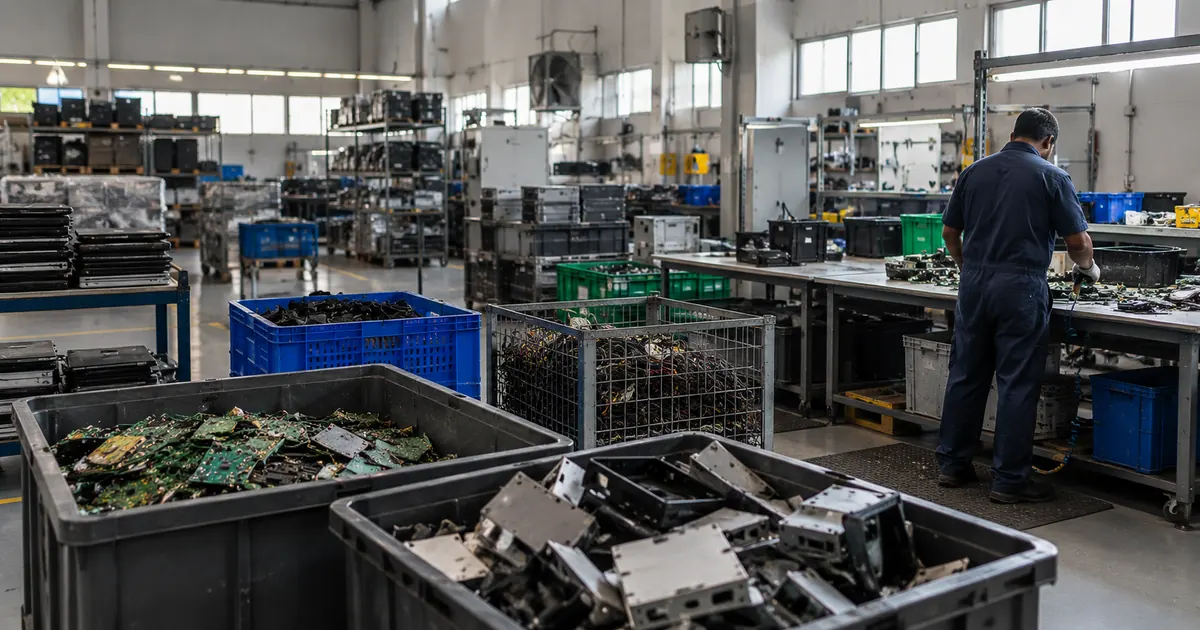
At our parent company’s MPCB-authorised plant in Waluj MIDC, equipment arrives under a signed manifest. Anything with data is wiped or destroyed first. Working devices are tested for reuse. The rest goes through dismantling, a shredding line and magnetic separation, and copper and aluminium are recovered in a furnace. Circuit boards, plastics and batteries are separated and sent on through their own channels, and the client receives a Certificate of E-Waste Recycling for the quantity processed.
What a company can control
- Hand e-waste only to a registered producer, refurbisher or recycler. For bulk consumers, that is the legal duty under Rule 8 of the E-Waste Rules, 2022.
- Ask where the material goes after pickup, and get it in writing.
- Do not sell by the kilo. A per-kilo buyer has every reason to route it informally.
- Keep the manifest and the recycling certificate.
- If you run a campus or a housing society, organise a collection drive so members’ electronics go the same way.
Related reading
Sources
- CPCB report to the National Green Tribunal, EA 04 of 2024 in OA 512 of 2018
- Toxics Link: Parliament answers on e-waste
- Global E-waste Monitor 2024 (ITU and UNITAR)
- NITI Aayog: Circular Economy of E-waste and Lithium-Ion Batteries (January 2026)
- Centre for Science and Environment: E-waste Management in India (2020)
- The National: Seelampur e-waste workers (March 2025)
- WHO: Soaring e-waste affects the health of millions of children
- IPEN and Toxics Link: informal e-waste recycling