E-Waste Disposal Near Me: How to Find an Authorized Recycler in Mumbai
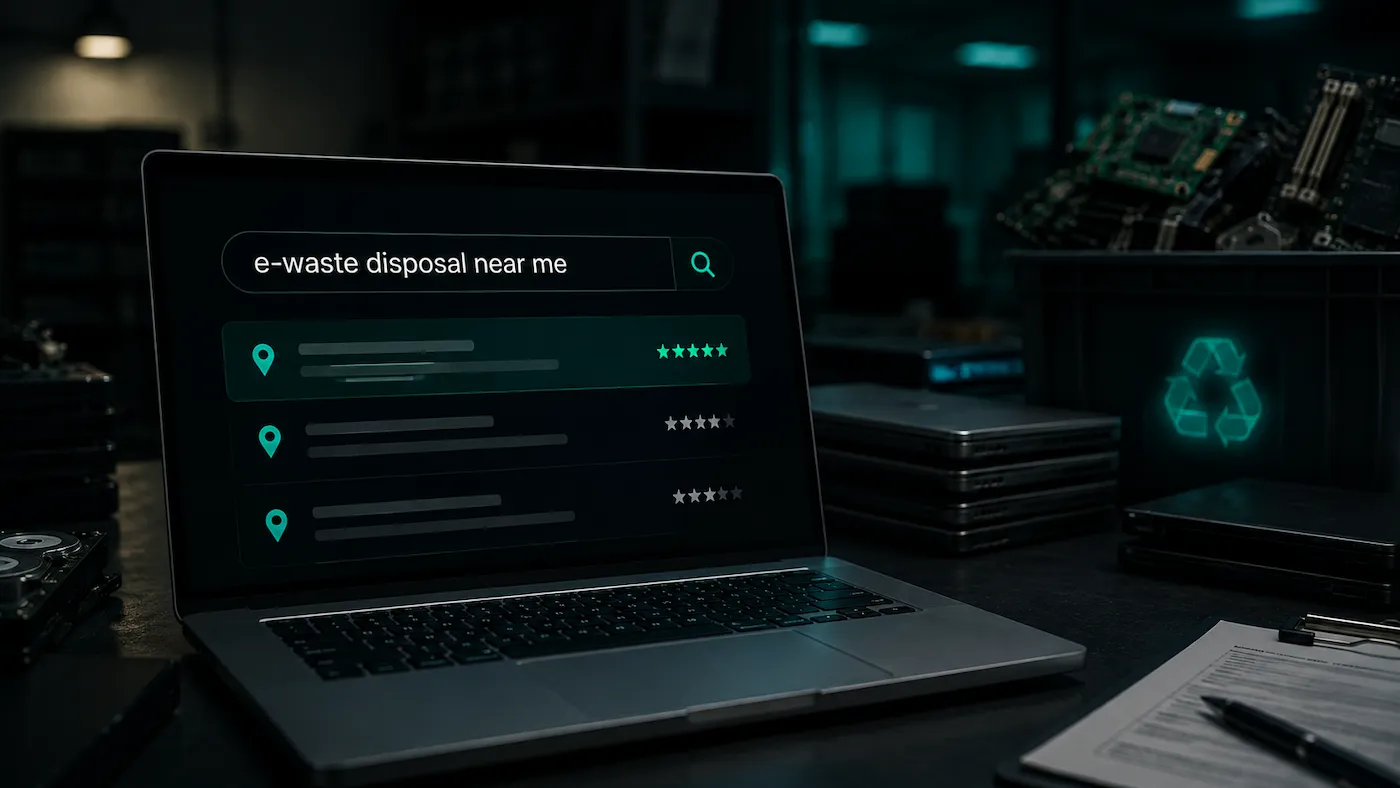
Search results for “e-waste disposal near me” mix three very different things: authorized recyclers, informal scrap buyers, and collection agents who pass material on to whoever pays most. The only way to tell them apart is to ask for the pollution control board authorization and read the expiry date and the categories on it.
For a household item, any authorized recycler works. For a business, proximity matters far less than documentation, because the collection is free and the vendor comes to you either way.
How to verify a recycler is authorized
“Authorized”, “certified”, “government approved” and “licensed” appear on almost every e-waste website in India, including plenty belonging to businesses that hold none of those things. The word costs nothing to type.
What is checkable:
- Ask for the Consent to Operate. In Maharashtra this is issued by the Maharashtra Pollution Control Board. It is a document with a number, an issuing date, an expiry date, and a list of the waste categories covered.
- Read the expiry date. Lapsed authorizations circulate as PDFs for years after they stop being valid.
- Read the categories. Authorization for one waste stream does not automatically cover what you are handing over.
- Check who holds it. Many collectors work as partners of an authorized facility rather than holding the authorization themselves. That is a normal and legitimate structure: PrivAce operates that way, through Greenlife Ewaste Recycling Pvt. Ltd. What matters is that the relationship is stated openly and the facility is named, so you can trace where your equipment went.
- Ask where the facility physically is. A vendor who cannot tell you where your equipment is processed is not in a position to tell you what happened to it.
Any vendor that hesitates at these questions has answered them.
Business disposal is a different problem
If you are searching this on behalf of a company, the “near me” part matters much less than you would expect.
For corporate volumes, collection is free and the vendor brings a vehicle to your premises. Whether their office is two kilometres away or twenty makes no practical difference to you. What does make a difference:
- Whether the data on your drives is destroyed before anything else happens. Standard e-waste collection does not include this.
- What documents you receive, and whether they would survive an audit twelve months later.
- Whether they will take the dead equipment too. Scrap buyers take what has value and leave the rest, which is how storerooms fill up.
- Whether they can handle your building's access requirements: gate passes, service lift bookings, material outward approvals.
We wrote a full comparison of the options in ITAD vs e-waste recycling vs scrap dealer.
Where collection actually happens in Mumbai
PrivAce collects across India, with free pickup in the Mumbai Metropolitan Region and Pune. Our office is on the Andheri-Kurla Road corridor in Saki Naka, so collection there is often quicker.
- Andheri, Saki Naka, Marol, MIDC and SEEPZ
- BKC, Bandra, Kalina and Kurla
- Powai, Vikhroli, Kanjurmarg and Ghatkopar
- Lower Parel, Worli, Dadar and Prabhadevi
- Navi Mumbai: Vashi, Airoli, Mahape, Belapur
- Thane: Wagle Estate, Ghodbunder Road, Kolshet
- Pune: Hinjewadi, Kharadi, Baner, Magarpatta (scheduled routes)
Six questions before you hand anything over
- Can I see your current pollution control board authorization? With the expiry date and the categories.
- Where is the equipment physically processed? A named facility and address.
- What happens to the drives? Wiped, degaussed, shredded: ask which, and when relative to resale.
- What documents do I get, and when? At collection, and after processing.
- Do you take non-working equipment? If the answer is conditional, you will be left with a pile.
- Is there any cost to me? For corporate volumes, collection should be free.
If it's a household item
If you are an individual with one old laptop or a television, you do not need any of the above. Take it to a municipal e-waste collection point, or to any authorized recycler: most will accept household drop-offs.
The one thing worth doing first: if the device stored anything personal, remove and physically destroy the drive, or take it to someone who will. Deleting files and factory resetting do not remove the data. That applies just as much to a household laptop as to a corporate one.
For businesses, the practical detail is on our corporate e-waste pickup page.